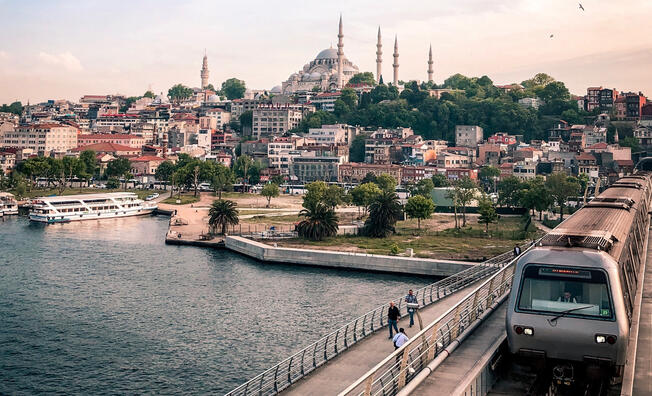
The Blue Mosque in the district of Old Istanbul as it stands today. Licensed for noncommercial use under Creative Commons.
Constantinople had a threefold life in the ancient world: once as a humble Greek merchant city, again as the centre of the late Roman world, and thrice as the gem of the Ottoman Empire. Even now, atop its ruins is the city of Istanbul, home to over 15 million people. Endowed with an excellent location on the Golden Horn of what is now Turkey and recognized as a prime trading city, it has been continuously inhabited for over 2,500 years and has been home to many cultures in that time, beginning with the Greeks and still evolving with today's Turkish population.
This project examines a slice of those two and a half millennia: its time as Byzantium, as Constantinople, and the time in between.
Mythical Origins (c. 660 BCE)
Our best source for the legendary origin story of Byzantium (or Byzantion, as it was known to the Greeks) is from Tacitus in Book VIII of his Annales. According to him, Byzantium was founded by King Byzas of Megara in 657 BCE after he sought the advice of the Pythian priestess to Apollo. The oracle's instructions were to establish a city opposite the blind men, the vagueness of which was in keeping with typical oracular predictions. Eventually, the king and his people decided that this likely referred to the city of Chalcedon, which was just across the straits of the Bosporus (see map at right). Chalcedon was not a city of literal blind people, but because the Chalcedonians had picked the worse of the two possible locations to build a city, the Greeks interpreted this to be a blindness towards opportunity.
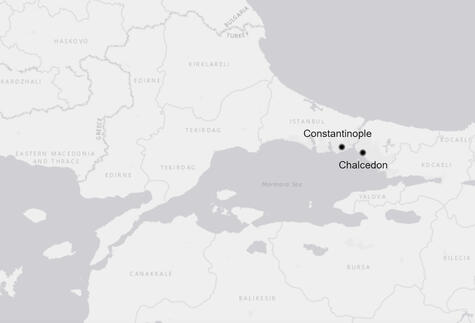
Map made by Kels Mapp, using National Geographic MapMaker Interactive.
Byzantium during the Archaic Age (660-340 BCE)
Byzantium was, by all accounts, a good place to build a city. Tacitus describes its location on the Golden Horn as being excellent in both lands and seas, well-given to farming and fishing and situated in an advantageous position for trading. It was a fairly wealthy city of traders for many years, which made it a prime target for Greeks and Persians alike.
513 BCE: Occupied by King Darius of Persia when the city pulled support during the Greek and Persian Wars.
478 BCE: Reconquered by Pausanias of Sparta and joined the Delian League.
411-408 BCE: As an effort to capture trading cities and prevent them from supplying Athens, Sparta took control of the city until their defeat by Alcibiades.
355 BCE: Declared its independence from the Athenian League.
340 BCE: Attacked by Philip II of Macedon, best known for being Alexander the Great's father. It was later briefly annexed by Alexander himself, but of course, that empire didn't outlive him.
Byzantium and Rome (150 BCE - 211 CE)
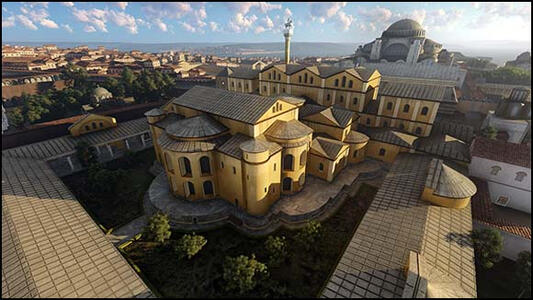
An reconstruction of what the finished Baths of Zeuxippos might have looked like. 3D modelling by Albrecht Berger.
Byzantium officially joined the Roman empire in 73 CE after a history of alliance dating back to roughly 150 BCE. Things continued largely without incident until the city sided with Pescennius Niger in his bid to usurp Septimius Severus during the Year of the Five Emperors. The city endured a two-year siege, but by the time that ended in 196 CE, it was in a state of disrepair. Septimius capped this off by burning down what remained.
Severan Repairs
At Septimius' behest, the city was rebuilt- and with some fancy new additions, no less! He added two new colonnaded streets, a marble-clad forum called the Tetrastoon, a complex of basilicas, a public baths called the Baths of Zeuxippos, and a hippodrome, used for chariot racing. Some of these renovations were unfinished by the time of his death in 211 CE.
Though left incomplete by the Severan dynasty, the imposition of these new construction projects served to bring symbols of Rome to the traditionally-Greek city of Byzantium. Throughout the empire, Rome sponsored building projects like these ones to bring romanitas, the culture and power of imperial Rome, to its colonies and territories. In this way, Byzantium was brought firmly into the Roman world.
Bibliography
Bassett, Sarah. The Urban Image of Late Antique Constantinople. Cambridge: Cambridge UP, 2004.
Berger, Albrecht. “Byzantium 1200.” Byzantium 1200 Project. 2007. http://www.byzantium1200.com/.
Kleiner, Diana E. “Rome of Constantine and a New Rome.” Lecture given as part of the Open Yale Courses series on Roman architecture, New Haven, CT, 2009. https://oyc.yale.edu/history-art/hsar-252/lecture-23.
Matthews, John. "The Notitia Urbis Constantinopolitanae". In Two Romes: Rome and Constantinople in Late Antiquity, 81-115. Edited by Lucy Grig and Gavin Kelly. Oxford: Oxford UP, 2012.
Ousterhout, Robert. Eastern Medieval Architecture: The Building Traditions of Byzantium and Neighboring Lands. New York: Oxford UP, 2019.
Tacitus. Annales. Translated by Alfred John Church and William Jackson Brodribb. Internet Classics Archive, 1994. http://classics.mit.edu/Tacitus/annals.html.
Treadgold, Warren. A History of the Byzantine State and Society. Stanford: Stanford UP, 1997.
Postscript
Hello! Thanks for coming on this journey with me. This project turned out to be surprisingly enjoyable, if not a tad bit more time-consuming than I anticipated. I really did get a little invested in the motivation behind spoliation and the survey of the Hagia Sophia- amazing art truly is one of the world's great unifiers. While Late Antique Rome is, respectfully, still not really "my thing", this was still a generally interesting experience. (I'm going to decline to use the word "fun"; Ambrose's letter still rankles.) Thank you for teaching it, and thank you for your compassion and understanding when I fell behind. It has meant more to me than I can express.
- Kels